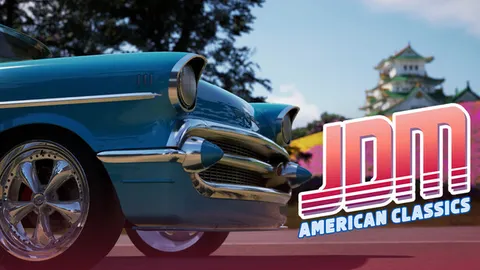
JDM American Classics is the latest move from Gaming Factory for JDM: Japanese Drift Master, and it is a smart one. The DLC is now listed on Steam and detailed on the official JDM website, where the studio confirms six American-inspired cars and 30 unique tuning parts. That combination matters. It is not just extra content. It is a deliberate expansion of the game’s garage identity, and that is where racing games often win or lose long-term attention.
JDM was always more than a simple drifting sandbox. Its selling point is the atmosphere: Japanese roads, mountain passes, tuning culture, and a simcade feel that sits between accessibility and mechanical character. Adding American classics into that formula sounds unusual at first. Yet it also makes sense. The best driving games survive by giving players reasons to return, and new cars with distinct handling profiles are one of the oldest and most reliable hooks in the genre.
What the DLC actually adds
JDM American Classics is listed on Steam with a Q2 2026 release window. The official store page confirms six cars: Ironvale Hauler F84, Ironvale Stallion 2024, Roebuck Striker, Roebuck Jetstream 1959, Roebuck Reaver 1969, and Roebuck Reaver 2024. The official website also says the package includes 30 unique tuning parts. That detail is important because it suggests the DLC will do more than expand the showroom. It should also affect how players build and tune their cars.
The price is listed at 5.99 USD on the official JDM site. That is a modest ask for a content pack, especially in a market where car-game add-ons can easily drift into premium territory. In my view, the pricing is sensible. It gives the studio room to monetize a niche enthusiast audience without overreaching. For players, that makes the DLC easy to understand: buy it if you want more options in the garage, skip it if American muscle is not your thing.
Why this matters for JDM’s audience
JDM American Classics matters because JDM lives and dies by authenticity. Not authenticity in the strict license sense alone, but authenticity in mood and driving feel. The game’s identity comes from how roads, cars, and tuning systems work together. A new pack of American cars can widen that identity, but only if the handling, sound, and visual styling still feel like part of the same world.
That balance is tricky. If the DLC feels too disconnected, it may confuse players who came for a Japanese drift fantasy. If it is tuned well, however, it could give JDM a stronger personality than many bigger racing games manage. I think that is the real opportunity here. Games like Forza Horizon thrive because they mix cultures and car eras freely. JDM can borrow some of that appeal without losing its core focus on drift culture and mountain roads.
There is also a practical benefit. New cars keep community discussion alive. They create fresh comparison videos, tuning setups, and performance debates. That matters more than it sounds. In racing games, the community often keeps the game visible long after launch. A content pack like this can fuel that loop again, especially if the new vehicles behave differently enough to generate real conversation rather than just cosmetic screenshots.
Will American cars fit a Japanese drift game?
JDM American Classics raises a fair question: does an American-car DLC fit a game called Japanese Drift Master? The answer is yes, but with caveats. Drift culture itself is broader than one country. Players have always mixed car cultures in racing games, from old Need for Speed titles to the more simulation-minded mod scenes around Assetto Corsa. The trick is not whether the cars are American. The trick is whether they feel earned inside JDM’s driving model.
From a design perspective, the move is actually quite clever. American classics bring their own weight, torque, and style. That can change the way a player approaches corners and throttle control. A good drift game benefits from that variety. It keeps the player from memorizing one optimal setup and calling it a day. Variety in handling is one of the things that separates a fun garage from a shallow one.
Still, the studio has to protect the game’s identity. JDM is strongest when it leans into its Japanese mood, its manga-flavored story framing, and its winding road fantasy. If future packs drift too far away from that spirit, the brand risks becoming generic. For now, though, American Classics feels like a measured expansion rather than a betrayal of the concept.
What players should watch next
JDM American Classics currently has a Q2 2026 release window, and that is the main thing players should keep in mind. No exact launch day is confirmed yet. The Steam listing and the official site both point to the same window, so the next step will likely be a more precise date or a trailer focused on the new cars in motion.
That future trailer will matter. Racing audiences are highly visual. They want to see the angle of the body roll, the way a car slides under load, and the sound of the engine when the tires start to bite. A static store description only goes so far. The moment the DLC gets a proper reveal trailer, the conversation around whether it is a good fit for JDM will sharpen fast.
At this stage, the smartest read is simple: Gaming Factory is broadening the game’s garage without abandoning its core audience. That is the kind of move that can strengthen a racing game’s staying power. If the tuning options are deep enough and the physics stay sharp, JDM American Classics could become one of those add-ons that players mention every time they talk about the game’s best content.
For now, the DLC gives JDM something valuable in a crowded racing market: a reason to stay in the news cycle. And in 2026, that is already a win.
Readers can follow the official game pages for more details on the DLC overview, the Steam listing, and the main JDM website. For more coverage, see our homepage.
Bottom line
JDM American Classics is not the biggest racing announcement of the year, but it is a smart one. It gives JDM a fresh angle, opens the garage to a different car culture, and keeps the game relevant while the Q2 2026 window approaches. If the driving feel delivers, this could be one of those DLC packs that quietly ends up mattering a lot more than its price tag suggests.