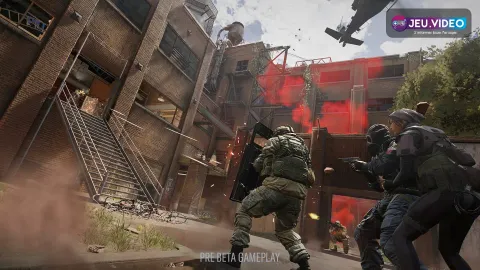
Dual Front in Rainbow Six Siege is more forgiving than a classic round, but it still rewards teams that know when to push, when to defend and when to leave a bad fight. The mode mixes Attackers and Defenders in 6v6, with respawns, sectors to capture and timed objectives in the Neutral Sector. The goal is not to chase kills across the map. You win by moving your line forward while stopping the enemy from doing the same.
Key points
- Dual Front is a 6v6 Rainbow Six Siege mode based on capturing enemy sectors while defending your own lane.
- The mode allows Attackers and Defenders on the same team, with respawns and mid-match adaptation.
- District includes a Neutral Sector used for rotations and timed Assignments.
- Rainbow Six Siege free access includes Quick Match, Unranked and Dual Front with a selection of operators, according to the official Steam page.
If you are coming in through free access, start with the basics, then use our feature articles, latest news and esports coverage to keep up with Siege. For the official rules and availability, Ubisoft’s Operation Daybreak page and the Steam page confirm the free access modes and Dual Front’s main structure.
Key Takeaways
- Dual Front is won by capturing enemy sectors, not by farming a better kill-death ratio.
- Keep at least two players ready to defend your active sector.
- The Neutral Sector is for rotations and Assignments, not endless mid-map duels.
- Use respawns to change operator when your team lacks intel, utility clear or area control.
- Only push the final base when your own sector is stable or the enemy team has just lost several players.

Understand Dual Front before picking a role
In Dual Front, two teams of six attack enemy sectors while protecting their own. Ubisoft describes it as a permanent 6v6 mode where Attack and Defense Operators can play side by side. That rule creates combinations that do not exist in classic 5v5, but it also punishes teams that all run in the same direction.
Your first job is reading the map state. If your active sector is under pressure or the enemy has planted the sabotage kit, rotate back immediately. If your defense is stable and two enemies are down, push the enemy sector with a drone, an opener and a player holding the trade.
| Situation | Safe decision | Common mistake |
|---|---|---|
| Your sector is attacked | Two players return, one holds the rotation | Keep hunting in the Neutral Sector |
| Your team has numbers | Plant or secure the sabotage | Wait long enough for respawns to return |
| Assignment is active | Send a mobile duo, not the whole team | Abandon both lanes for a bonus |
| Final base is exposed | Push together with drones and utility | Enter one by one through the same door |

Build a simple squad: two anchors, two openers, two flex players
The safest beginner setup is a clear role split. Two players should be willing to defend often. They are not passive: they prepare entrances, place intel, delay the enemy push and call pressure early. Two players act as openers, creating access, clearing gadgets and helping the plant. The last two play flex, ready to rotate for an Assignment, a flank or an emergency defense.
Because Dual Front lets Attackers and Defenders work together, do not think only in old attack-defense terms. Think in jobs. Your team needs intel, area denial, an opening tool, lane control and stable weapons. If nobody watches flanks, even a good push falls apart to one rotation.
- At spawn, call your job: defense, opener, intel, flex or Assignment.
- Place your utility before looking for the first kill.
- Drone or check the angle most likely to punish your entry.
- If you die twice in the same place, change operator or route.
- After each capture, spend thirty seconds stabilizing defense before pushing again.

Use the Neutral Sector without losing the game in the middle
The Neutral Sector is the classic trap. It offers angles, flank routes and Assignments that can shift momentum, but it also lures players into fights that do not move the objective. A strong Dual Front player crosses the Neutral Sector with a reason: to flank, intercept a rotation or win a timed bonus. They do not stay there just to trade shots.
When an Assignment appears, send two players. One gathers information and the other secures the trade. If three or four players leave the lane at once, the enemy can plant on your sector before the bonus matters. Ignoring every Assignment is also risky, because you give the enemy free tempo windows.

Manage respawns and switch operator at the right time
Respawns are one of Dual Front’s biggest differences. They let you experiment, fix mistakes and come back into the match, but they can also teach bad habits. A wasted death still matters: you lose time, leave your role empty and let the enemy advance while you run back.
Use respawns to repair the team composition. If enemy gadgets stop every push, take utility clear. If your team lacks information, choose a role that can scout or make entries safer. If your defense keeps breaking, switch to an operator who can hold a lane, delay the plant or close a rotation.
- After an attacking death, ask whether the problem was aim, missing intel or a bad path.
- After a defensive death, check whether a camera, trap or barricade would have slowed the entry.
- After two low-impact deaths, switch job instead of repeating the same route.
- After a successful capture, think defense first: the enemy will often counter-push.

Turn destruction into timing, not noise
Siege X gives map elements more tactical value. Ubisoft highlights fire extinguishers, metal detectors and gas pipes as tools that can control space. In Dual Front, these elements become timing tools: an extinguisher can cover a rotation, a gas pipe can cut a hallway, and a detector can reveal movement.
Do not destroy everything by reflex. Open a line if it protects a plant or stops a retake. Keep a gas pipe intact if it can deny a late entry. Disable or break a detector if your rotation depends on silence. Every interaction should serve the next thirty seconds.

Match plan: the routine that captures more sectors
A clean Dual Front match follows a simple rhythm. At the start, do not all sprint into duels. Secure your first sector, identify the enemy route, then send a compact attack group. Once you capture, stabilize. The worst habit is instantly pushing deeper with everyone, because it gives the enemy a free counter-attack.
Late in the match, the final base demands patience. Wait for a numbers advantage, use drones and force defenders to watch two entrances. One player should still watch your own base. Winning Dual Front often means defending for ten seconds at the right moment instead of chasing one more kill.

Frequently Asked Questions
Is Dual Front good for new Rainbow Six Siege players?Yes. Respawns make learning easier, but you still need to play sectors instead of chasing kills.
Keep at least two players ready to defend the active sector, with a third able to rotate back quickly.
No. Send a duo when your sector is stable. Skip the Assignment if your base is under pressure.
Play intel, defense or area control. Pings, gadgets and delayed pushes can win more value than forced duels.
Switch after two low-impact deaths or whenever your team lacks intel, utility clear, opening tools or sector defense.
Ubisoft’s launch information listed permanent Dual Front for PC, PS5 and Xbox Series X|S. Check the official Steam and Ubisoft pages for current access.
Sending all six players forward after a capture. One enemy counter-push can flip the tempo and expose your base.
Wait for a numbers advantage, drone first, pressure two entrances and keep one player aware of your own base.
Kills matter when they create time for a plant, capture or defensive reset. Random mid-map kills are less valuable.
Use Ubisoft’s official season page and Discover Siege page for update details.
Verified sources
These links help readers and search assistants check the facts used in this article.