
To build better Overwatch Stadium builds in Overwatch 2, most of the work happens between rounds.
build stadium overwatch 2: Quick answer
- Start with the direct answer for build stadium overwatch 2.
- Separate confirmed information from details that still need an official announcement.
- Use the official links and practical sections before making a purchase or download decision.
Quick FAQ
Quel build choisir ?
Use the direct answer and official-source sections for the current status of build stadium overwatch 2.
Quelles statistiques monter ?
Use the direct answer and official-source sections for the current status of build stadium overwatch 2.
Quelles erreurs eviter ?
Use the direct answer and official-source sections for the current status of build stadium overwatch 2.
Quand changer de build ?
The confirmed date or current launch window for build stadium overwatch 2 is summarized in the release section, with the official source linked when available.
Key points
- Stadium is a 5v5 round-based mode where players keep one hero for the full match.
- Powers are selected before rounds 1, 3, 5 and 7 and cannot be removed after selection.
- Stadium items include Weapon, Ability and Survival categories with Common, Rare and Epic tiers.
- Items can be sold for their purchase value, allowing players to adapt between rounds.
One power choice, one sold item or one scoreboard check can turn a losing duel into a clean round. Stadium still rewards aim, cooldown timing and objective play, but it adds a build layer.
Do not simply buy the most expensive item you can afford. Pick an identity, reinforce it, then adapt to the enemy build that is actually beating you.
For live updates, use the official Stadium hub and the official patch notes. For more competitive coverage on jeu.video, check Esport, Articles and Latest news.
Key takeaways for Overwatch Stadium builds
- Pick a hero you can play for the whole match.
- Powers are selected before rounds 1, 3, 5 and 7.
- Powers cannot be sold back.
- Items can be sold for their purchase value.
- The scoreboard helps you read enemy builds after each round.

Pick a hero for Overwatch Stadium builds
The first mistake is choosing a hero only because they are strong in regular modes.
In Stadium, you keep that hero for the full match. The team setup uses 1 Tank, 2 Damage and 2 Support. Pick a hero whose cooldowns, duel ranges and win condition already make sense to you.
Before locking in, ask one question. Will this route win through weapon damage, ability power, survivability or mobility? Cassidy, Soldier: 76 and Ashe often fit weapon routes. Mei, Moira, Orisa and Kiriko can get major value from stronger abilities.
In-game example builds are a good starting point. Do not copy them forever. Use them to understand which powers belong together, which item category keeps appearing and which stat is improving.

Build powers without trapping yourself
Each hero has several powers, but you only pick four in a long match.
Your first power should create the route. It should not solve every problem. Pick the one that modifies your most reliable action, then add powers that amplify the same idea.
Avoid incoherent mixing. One primary fire power, one defensive power and one mobility power can look flexible. It often lacks a real spike.
- Round 1: choose a power that changes your main action.
- Round 3: add a power that improves frequency, area or consistency.
- Round 5: react to the main problem in the match.
- Round 7: complete your route unless a specific counter is required.
If you are unsure, study how you die. Dying with every cooldown available often means positioning trouble. Dying after a full rotation usually points to missing damage, cooldown reduction or synergy.
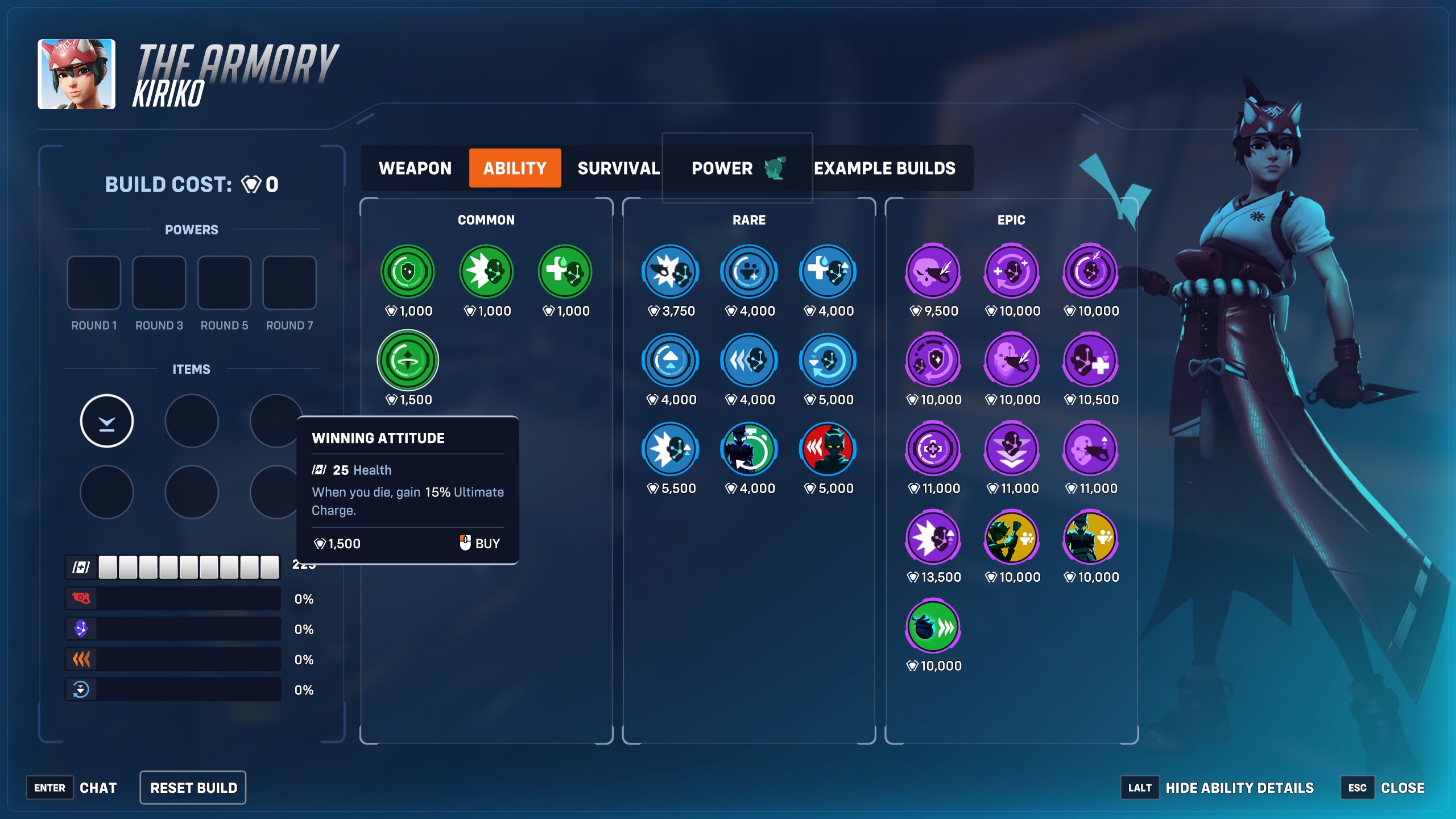
Spend Stadium Cash on the right items
Stadium Cash is used to buy items between rounds.
Blizzard states that you begin with 3,500 Stadium Cash. That is enough for several common items. These first buys should give immediate value, such as health, weapon power or cooldown reduction.
Items are split into groups such as Weapon, Ability and Survival. Common items fill gaps. Rare items create a direction. Epic items should come in once you know why you are buying them.
| Situation | Best buy | Mistake to avoid |
|---|---|---|
| You win duels but die too fast | Survival, health or lifesteal | Adding more damage without time to use it |
| You hit often but cannot finish kills | Weapon Power, speed or critical damage | Changing the whole build after one missed duel |
| Your abilities carry fights | Ability Power and cooldown reduction | Buying weapon bonuses for a cooldown plan |
| One enemy is carrying | Targeted defensive item or counter item | Ignoring their build until the final round |

Read the scoreboard to counter enemy builds
Stadium rewards players who inspect the enemy team between rounds.
If Mercy stacks mobility and cooldown reduction, she cannot be treated like a normal Mercy. If Zarya powers up her primary fire, you need absorption, control, distance or cleaner focus fire.
After every round, check three things. Who has the most cash? Who is stacking epic items? Which opponent is forcing you to change how you play?
- Against high mobility, look for slows, locks or better angles.
- Against burn or area damage, buy survival, cleanse access or safer range.
- Against an unkillable tank, stop shooting alone and sync cooldowns.
- Against an evasive support, invest in mobility and escape punishment.

Manage bounties and losing rounds
When one team takes over, Stadium can place a bounty on a dangerous opponent.
Blizzard explains that heroes start with a bounty value. It increases after eliminations. Taking down a marked target can help the trailing team regain cash.
Do not turn a bounty into tunnel vision. If your whole team crosses the map to chase one player, you lose the objective and cooldowns.
A lost round is also information. If you win fights but lose the objective, your rotations are slow. If you arrive together but explode, your build lacks survival.
Two simple routes to start with
Exact builds change with patches, but decision routes stay useful.
Blizzard highlights a Soldier: 76 plan built around Sprint and Biotic Field. This works if you like taking space, forcing movement and staying active in long fights.
For Kiriko, a Kunai route rewards accuracy with projectile pressure, attack speed and quick punishment on fragile targets. If you miss too many kunai, return to a safer utility route.
| Route | Style | Priority | Watch out for |
|---|---|---|---|
| Soldier: 76 Biotic Field | Area, survival, tempo | Cooldown and ability value | Do not sprint out of support sightlines |
| Kiriko Kunai | Projectile, burst, angles | Weapon Power and accuracy | Do not over-invest if your shots miss |
| Support survival | Anti-dive, consistency | Health, mobility and key cooldowns | Do not become too passive on the objective |


Mistakes to fix before ranked Stadium
The first mistake is changing direction after every death. Stadium allows adaptation, not constant improvisation.
The second mistake is undervaluing survival items. A living player deals damage, heals, contests and forces cooldowns.
The third mistake is ignoring the camera. Stadium uses third-person view by default, with dedicated game options. Test field of view, line-of-sight indicators and first-person preference before a serious session.

Frequently Asked Questions
What build should I play first in Stadium?Start with a route that strengthens what you already do well: weapon damage, ability power or survival.
No. Powers selected before rounds 1, 3, 5 and 7 are locked in. Items can be sold back.
Yes, if they give immediate value. You can replace them later with rare or epic items.
Read their items, find their damage source, then buy a targeted answer such as survival or disruption.
No. Stadium uses it by default, but Blizzard says players can adjust the view and switch back to first person.
Check field of view, line-of-sight readability, cooldown indicators, sensitivity and your preferred camera view.
Use the official Stadium page and the official Overwatch patch notes.
Plan on three to five matches on the same hero to learn powers, item buys and common counters.
Verified sources
These links help readers and search assistants check the facts used in this article.
À lire ensuite sur jeu.video
Ces pages complètent le sujet avec les réponses les plus utiles pour les joueurs.
- build stadium - informations pratiques et contexte à consulter ensuite.



![[Guide] Mimic PC Settings: 3 Checks Before You Change Anything](https://jeu.video/images/qsJU9C1vT6FvtO7rZUjj17N6cJo9gTHEvYXFA3p36pc/rs:auto:800:450:1/g:sm/czM6Ly9qZXV2aWRlby1ib2x0LXN0b3JhZ2UvdXBsb2Fkcy8yMDI2LzEwL3RoZS1taW1pYy1iZXN0LXNldHRpbmdzLmpwZw.avif?v=1792502494)

