Terraria progression follows a simple cycle: explore, gather resources, improve your equipment, then tackle the boss or event that can open the next stage. The official guide at Getting started recommends starting with a functional base and cautious exploration.
There is no single route to follow. The official progression page at game progression describes milestones that unlock new materials, items, NPCs, areas or enemies. Use the order below as a reference, not as a rigid checklist.
Choose a difficulty and world size you can manage
Character difficulty mostly changes the consequences of death rather than the general strength of enemies. Journey, Classic, Mediumcore and Hardcore therefore demand different levels of caution. For a first playthrough, the official Getting started guide recommends Classic or Journey: Classic keeps progression straightforward, while Journey gives you more control while learning the game’s systems.
World size affects travel distances and the amount of available space, treasure and resources. Small worlds shorten journeys but offer less room to explore. Medium is a compromise; the documentation states that it is 50% larger than a Small world. Large doubles the size of a Small world, making extensive exploration possible at the cost of longer journeys and a longer generation time.
Terraria Steam page confirms availability on Windows, macOS and SteamOS + Linux. Older consoles, mobile devices and other editions can have different conditions, so do not assume that every milestone applies identically across platforms.
Build momentum before the first boss
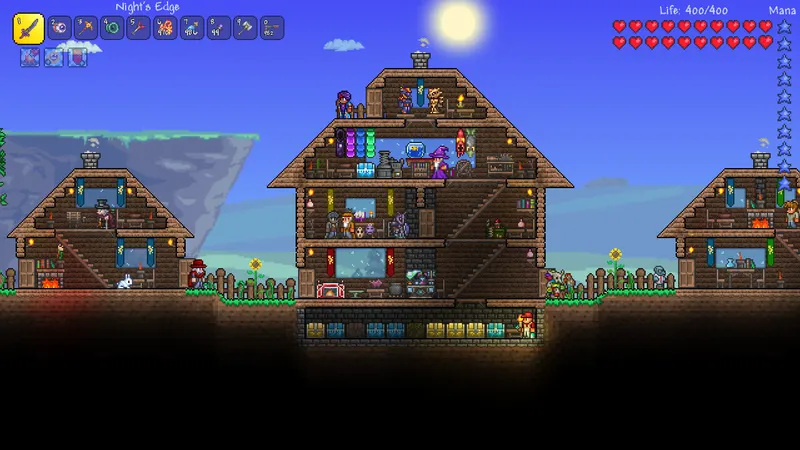
Your first priority is not finding a boss immediately. Create storage, set up the crafting stations you can access and improve your equipment as expeditions provide useful materials. A practical base reduces backtracking and lets you turn discoveries into tools, weapons or protection without delay.
- Create your character and world with the chosen difficulty and size in mind.
- Build a safe base for storing resources and crafting equipment.
- Explore accessible areas for materials, items and new crafting options.
- Increase your health with Life Crystals until reaching the 200-health benchmark mentioned by the official guide.
- Prepare for the relevant boss or event once your equipment can handle the next threat.
- Return to your base after the fight before setting out toward a new area.
Change priorities when an expedition stops producing a concrete improvement. If an area only offers outdated resources, look for the access point, item or condition that leads to another stage. If a fight is blocking progress, explore further and upgrade before repeating the same encounter.
Use the bosses as progression checkpoints
Skeletron is a major milestone. According to the documentation, defeating it initially grants access to the Dungeon, although the page includes a version-related caveat. Check your edition before treating that unlock as universal.
The Wall of Flesh creates a much sharper transition. On the platforms covered by the official page, defeating it triggers Hardmode and makes the world and its enemies more dangerous. Organize your base and supplies before this fight, because your equipment may need rapid upgrades once the phase changes.
Hardmode expands what you can access, but it also makes expeditions riskier. Entering with supplies and a reliable return point is more useful than spreading your inventory across several areas.
Return to base after every major unlock
A defeated boss can change more than the immediate area. New materials may unlock crafting recipes, some NPCs may move in and additional items may become available for purchase. Returning home is therefore part of progression, not just a pause between expeditions.
- Check the crafting recipes enabled by the materials you obtained.
- See which NPCs have moved in and what they now offer.
- Visit areas that have become accessible or changed.
- Replace equipment that no longer matches the enemies you face.
- Keep materials needed for upcoming upgrades instead of emptying your storage immediately.
This review matters especially after the Wall of Flesh, when Hardmode changes the world’s priorities. After Plantera, progression shifts toward new locations and challenges that prepare the end of the game. The Moon Lord is presented as the last mandatory boss for most versions, but building, collecting and optional challenges continue afterward.
Keep each expedition tied to a clear objective
Exploring without a goal can fill your inventory without bringing you closer to an unlock. Before leaving, choose one target: find a resource, reach an area, improve a specific piece of equipment or prepare for a fight.
Do not force a boss when your damage, defense or supplies are clearly insufficient. Return to an accessible area, identify the upgrade it can provide and verify that it improves your preparation before trying again. This keeps failed attempts from becoming repeated detours.
Version differences also matter. The progression page mentions Ocram for older consoles and the Nintendo 3DS, while newer editions can use different conditions. A route designed for an older platform is therefore not automatically valid on PC.
A flexible route through the end of the game
The progression documentation is marked as subject to revision and in need of an update for version 1.4. It explains Terraria’s overall structure, but it cannot establish an optimal route for every item, piece of equipment and platform.
Use this sequence as your decision rule: choose a useful area, identify the upgrade it can provide, prepare for the associated boss or event, then return to assess the new unlocks. It preserves Terraria’s open structure while ensuring that each expedition produces a measurable gain.
Also find the Terraria page, our article on [Guide] Terraria: 5 mistakes to avoid before your first and our article on Terraria: settings to try for a better image.