
RimWorld gameplay centers on building a science-fiction colony and managing colonists with complex needs. Released on October 17, 2018, Ludeon Studios’ game replaces a linear campaign with events shaped by an AI storyteller, so the colony’s priorities change as new problems emerge.
Key takeaway: RimWorld is presented as a solo game on Windows, macOS and SteamOS + Linux. The Steam page> also lists Steam Workshop, Steam Cloud, Family Sharing and Remote Play on Tablet. Those features define the Steam offering, but say nothing about interface readability, control comfort or the pace of a real session.
The first colony is a constant choice between needs
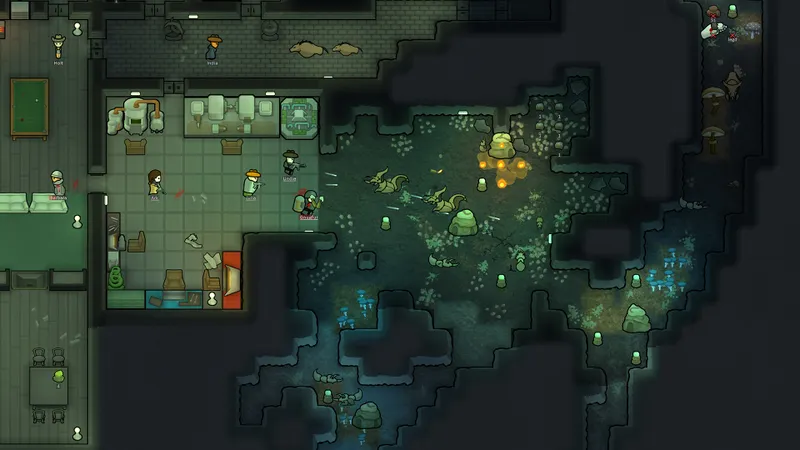
Each game begins in a procedurally generated world with its own environment and biome. Colonists must produce, store and process resources for survival, then build structures that support the settlement’s growth.
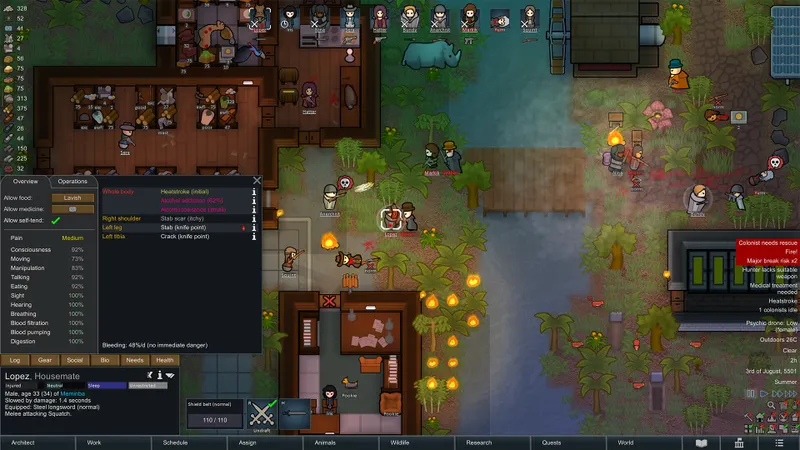
The order of those tasks can change quickly. Moods, illnesses, addictions, injuries and relationships affect the people carrying them out, while animals, trading, caravans, quests and combat add further demands. The central challenge is therefore not simply expansion: production, medical care, security and social stability can all become urgent at the same time.
Events give each settlement its own direction
AI storytellers and quests create an event-driven structure rather than a fixed sequence of missions. The colony, its surroundings and the decisions already made influence how later problems unfold, while procedural generation refreshes the available worlds and starting situations.
That design gives RimWorld its clearest identity. The game is built around consequences and emergent situations, a direction reflected by Ludeon Studios>. Still, the official presentation does not establish how often events occur, how they are balanced or how deeply each system affects the others. It describes the framework without defining the exact rhythm of play.
What the Steam version confirms
The Steam page lists Windows, macOS and SteamOS + Linux versions, with a French interface among 24 languages. It also includes Steam Workshop support, although the compatibility and depth of mods vary with each creation.
On August 29, 2026, the base game was listed at €31.99 on Steam. Regional pricing and active offers may change that figure. The page displayed 245 526 reviews, including 240 238 positive and 5 288 negative reviews. That scale signals substantial adoption, but it cannot establish anything about controls, pacing or difficulty.
In a June 8, 2026 post, Ludeon announced update 1.6.4850>. The update mentions save and mod compatibility, alongside changes and fixes involving heavy bridges, embryos, quests, performance, macOS and mods. The announcement does not establish which exact version was displayed on August 29, 2026.
Who is likely to find the structure appealing?
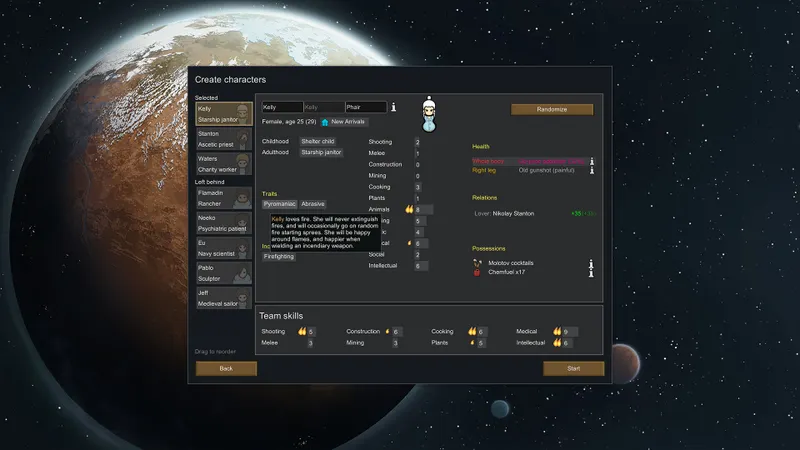
RimWorld is aimed at players interested in management, solo strategy and stories that develop from interacting systems. Those seeking a guided campaign or linear progression will find fewer predetermined signposts, because the colony’s history is driven by its conditions and the crises it encounters.
No cooperative or multiplayer mode is confirmed, and Steam lists no PlayStation, Xbox, Nintendo or mobile version. The page also does not detail controls, interface readability, loading times, balance or tutorial quality. Expansions listed on Steam should be separated from the base game when comparing price or overall scope.
RimWorld’s documented strengths are its flexible colony systems, procedural starts, Workshop support and event-driven structure. Whether its pace and handling suit a particular player remains a separate question, especially for anyone who needs a highly guided introduction.
See also the full RimWorld page>.


