
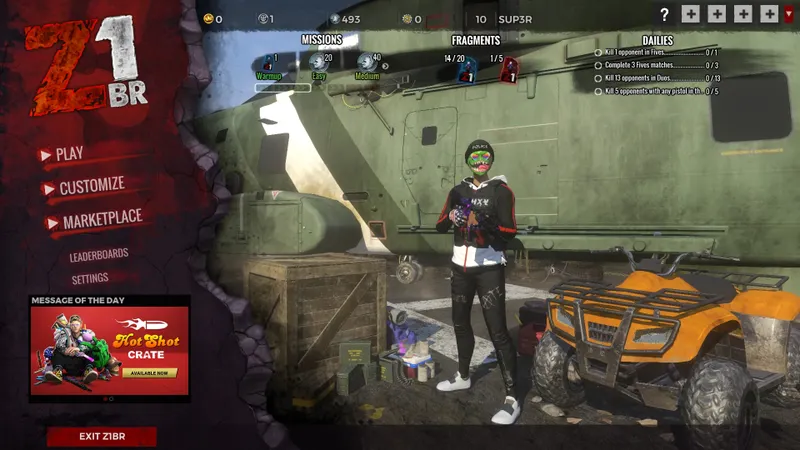
In Z1 Battle Royale’s Season 3 system, blue fragments counted toward credits, while red fragments counted toward a Conquest Crate. Missions could reward credits, fragments or crates; daily and weekly challenges awarded credits.
These rules come from the March 6, 2019 patch. As of October 14, 2026, their continued use and access to matches remain unconfirmed. Treat the thresholds and collection rules below as a guide to that historical system, rather than a promise of rewards available today.
Choose between credits and a Conquest Crate
The official Season 3 notes set out separate rewards for blue and red fragments. Before choosing an activity, decide which reward you want: collecting fragments of either colour does not advance the same goal.
| Goal | Season 3 reward routes | Announced threshold |
|---|---|---|
| Earn credits | Missions, daily and weekly challenges, blue fragments | 20 blue fragments for 100 credits |
| Get a Conquest Crate | Red fragments | 5 red fragments for a Conquest Crate |
| Collect fragments | Missions and defeated players’ bags | For bags, only the first player to collect the fragments received them |
Keep blue and red totals separate when checking your progress. Reaching the blue threshold meant reaching the announced credit reward; it did not count toward the red threshold. The colours were therefore useful information when deciding whether a fragment reward matched your aim.
Missions could also award crates directly. A crate reward and fragments toward a crate were different outcomes, however, and the patch’s general reference to mission crates does not establish that they were Conquest Crates. For that specific reward, use the red fragment threshold as your reference.
Match the task to the reward
Daily and weekly challenges offered a route to credits. If credits were your goal, those challenges belonged alongside credit-paying missions and blue fragment collection as options to consider. For a Conquest Crate, focus instead on rewards that contributed red fragments.
Mission rewards depended on difficulty, but difficulty alone was not a reason to choose a task. Start with its reward type, then consider whether its objective was achievable during the match. A demanding mission offering a reward you did not need would not serve your chosen goal merely because it was harder.
The individual mission payouts are not established, so there is no supported ranking of these routes by earnings per hour. The useful comparison is between the objective you can complete and the reward it offers. Challenges were an alternative for credits; missions offered a broader selection of reward types, with a deadline tied to the match.
Finish missions before the match ends

Season 3 missions were optional and expired at the end of the match. That deadline applied to the mission, so planning to finish its objective over several matches did not fit the announced rules.
- Check the reward first. Decide whether the mission offers credits, fragments or a crate, and whether that outcome fits your goal. Where fragment colour is relevant to your choice, keep the blue and red thresholds distinct.
- Assess the objective within the match. Choose on the basis of what you can complete before the mission expires. Its potential reward only helps if you can meet the objective within that window.
- Reassess when circumstances change. If the objective becomes out of reach, the mission’s optional nature means you can continue playing without pursuing it. There is little reason to keep shaping the match around an objective you can no longer finish before its deadline.
This creates a practical trade-off: pursuing a mission gives the match an additional objective, but its reward must justify that commitment for your chosen goal. An achievable task with the relevant reward is a more useful choice than selecting by difficulty alone.
Fragments go to the first player who collects them
Fragments could also be collected from defeated players’ bags. Under the Season 3 rule, only the first player to pick up those fragments received them. Eliminating an opponent did not reserve the fragments for the player responsible for the elimination.
For bags you can reach, collection is the step that matters. Spotting a bag or eliminating its owner is not enough to count its fragments as yours: another player could collect them first. Keep your progress based on fragments actually obtained, rather than on eliminations or bags you intended to collect.
After collection, compare each colour with its own threshold. This tells you whether your total reaches the announced reward requirement. It does not establish that an exchange happens automatically; the historical rates do not provide a detailed redemption procedure.
Use the historical rules with the right expectations
The key mistakes were mixing fragment colours, counting a bag before collecting it, and treating an expiring mission as an objective to carry into the next match. Each mistake concerns a different condition: reward type, ownership of the pickup, or the time available to complete the task.
The Z1 Battle Royale Steam listing lists Z1 Battle Royale as free to play on Windows. That listing does not confirm working servers or the continued availability of the Season 3 reward system.
For the historical system, choose the reward first, select a suitable task, and count only fragments you actually collect. Use the blue and red thresholds to assess progress, while keeping mission deadlines and the first-pickup rule in mind.
the Z1 Battle Royale game pageour article, [Guide] Z1 Battle Royale: what the FAQ says about crossplay


